
Barcelona Cultura

2024 community centre indicators


A summary of the main indicators of community centre activity in 2024 was presented at the annual meeting of community centre management teams organised by the Directorate of Cultural Outreach at the Barcelona Institute of Culture to assess activity.

In this edition, data was provided by 52 community centres and in general the figures are very positive.

On one hand there is an increase in the indicators, compared to 2023, in three main areas of activity at the centres: training, dissemination programmes and the use of facilities by organisations.

On the other, the number of people using community centres is up by 2% (to 27% of Barcelona’s population) and user ratings have improved among the population in general and users in particular.

Finally, the figures highlight the increase in the amount allocated to subsidies for the unemployed or people with disabilities, to help them access options offered at community centres.

If you would like to see detailed annual data for each centre you can find them in the corresponding section for community centres on this website.

You can also follow the evolution of registration for training activities in the recent data section.

You’ll find all the information on activity at the centres on the website for the community centres network.
Museum and exhibition centre visitors survey 2024


These are the results of the 2024 survey of visitors to museums and exhibition centres in Barcelona.

Promoted and coordinated by the Barcelona Institute of Culture since 2014, this survey analyses the profiles of individual visitors to the museums and exhibition centres that take part.

The number of venues participating in the study has risen to 21 centres this year, with the addition of the National Art Museum of Catalonia and the Fabra i Coats Art Centre.

Another new aspect of this edition is the inclusion of surveys conducted during the online purchase process for some centres, as internet ticket sales are an option increasingly favoured by visitors to these facilities.

Over 58,000 face-to-face surveys have been analysed in all, along with nearly 200,000 online surveys, a representative sample of the 4.7 million plus individual visitors to the various centres.

Access the interactive report with results for 2014 – 2024 from the home page of this website or by using this link.

You can find more information in the following document:


March 8th: Gender and Culture


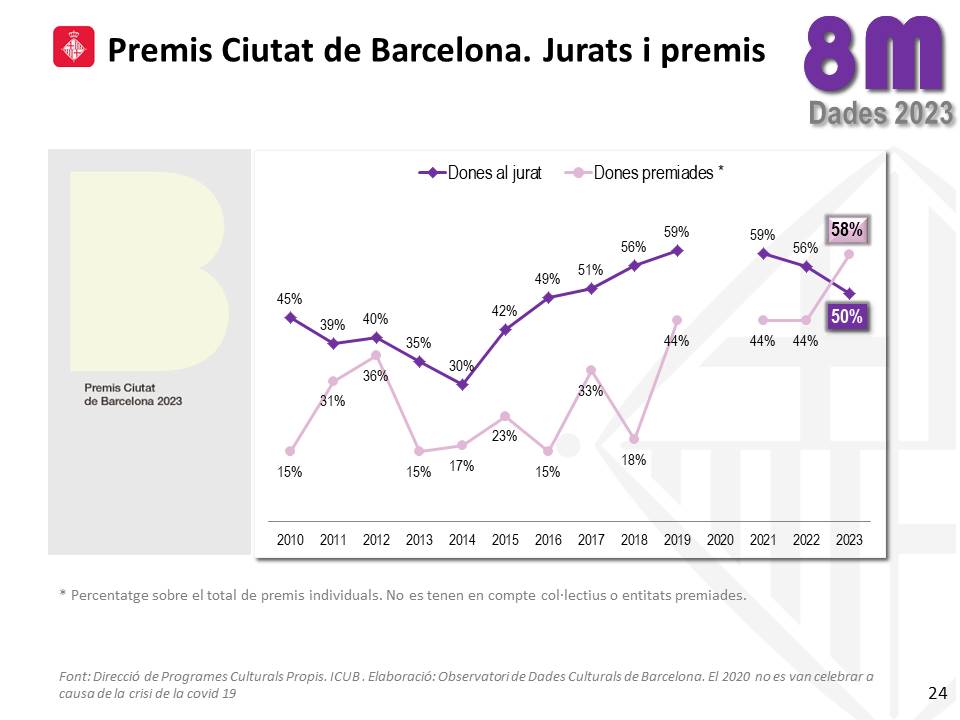
Once again, on the occasion of the celebration of March 8th, International Women’s Day (IWD), the Barcelona Cultural Data Observatory has updated the collection Some Gender and Culture Data.

On this occasion, we highlight the data from the Ciutat de Barcelona Awards, which are given around Santa Eulalia. The number of women awarded has increased to 58% of the awards granted this year, a very significant figure compared to previous years.

The annual collection we present helps to visualize the different realities regarding the presence of women in the culture promoted by the Barcelona City Council. There is still much progress to be made, and we continue to work on increasing the available information.

Survey on cultural rights in Barcelona


The survey on cultural rights in Barcelona, promoted by the City Council, analyses the diverse ways in which city residents experience culture and how the inequalities experienced by some people impact their ability to exercise their cultural rights. Barcelona is one of the few cities in the world that has a survey which enables it to define and evaluate the state of the cultural rights of its population.


Some results

The results of the survey show that in some neighbourhoods, it is more difficult to exercise the right to culture, given the accumulation of factors that generate inequalities. However, the survey also lays bare the fact that the neighbourhood is a source of cultural life. The right to culture is experienced in many neighbourhoods through activities and spaces that are not always recognised as cultural. This seems to be a growing trend in the post-pandemic context.

The survey also shows that everyone has cultural needs and that people give value to culture, regardless of which neighbourhood they live in.

Another key factor that conditions people’s cultural activity and their ability to exercise their cultural rights is the family environment. One of the areas where inequalities linked to the family are most evident is in artistic training or education. Likewise, the survey shows that inequalities affect the cultural rights of children. In more affluent neighbourhoods and family environments, children are able to exercise their cultural rights more and more often.

Lastly, the survey also shows the importance of gender identity and (migratory) origin for people’s cultural life. In this regard, the closure of cultural spaces affects everyone, but some more than others.


For more information, go to:

Culture in times of pandemic (II)


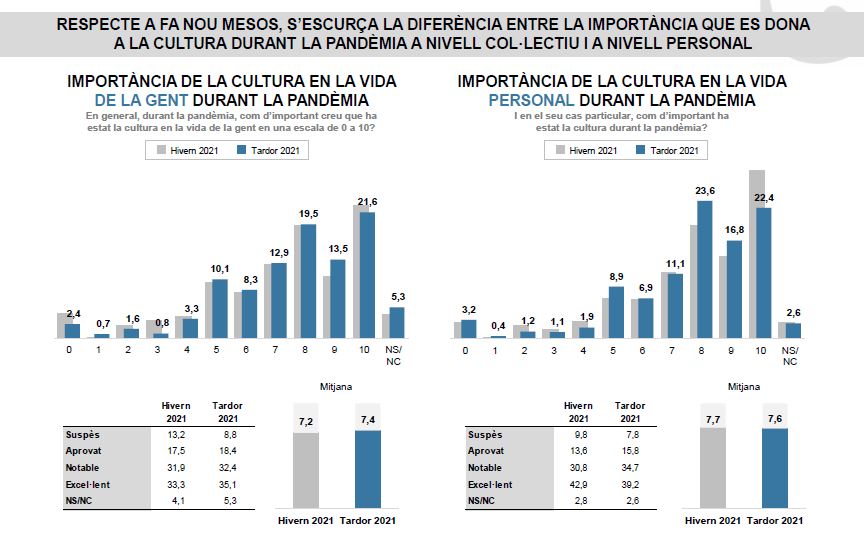
During the last quarter of 2021, and carrying on from last autumn’s survey, the Barcelona Institute of Culture included a series of questions in the GESOP’s quarterly Omnibus, in order to monitor the importance of culture during the pandemic.

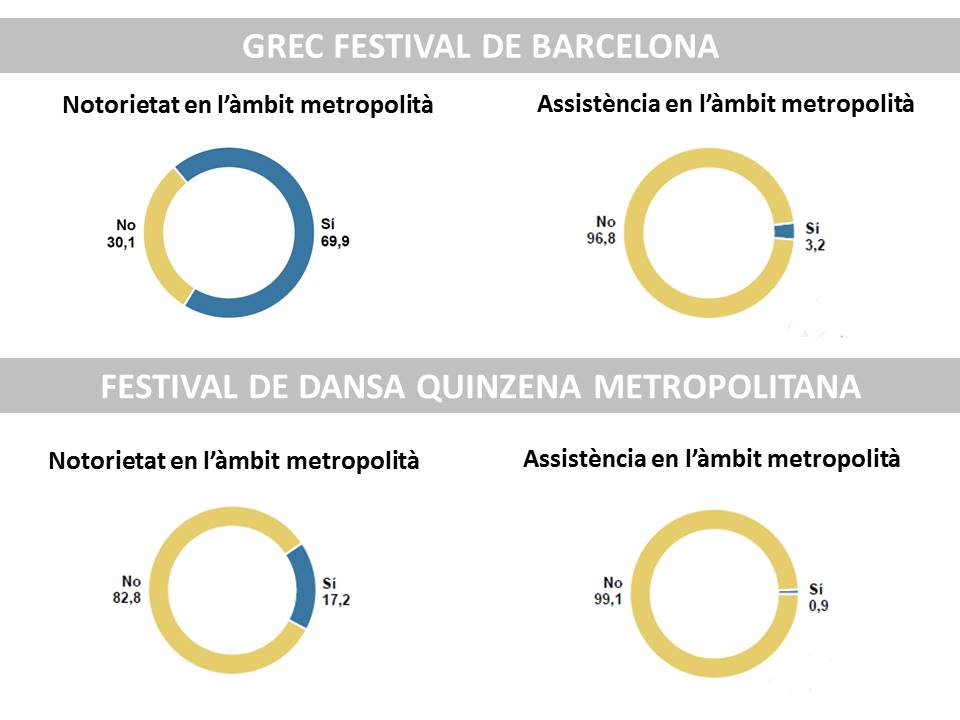
As a new feature, people were questioned on their knowledge of the Grec Festival, its projection beyond the city, and the Quinzena Metropolitana, Metropolitan Dance Fortnight festival, held in the Metropolitan Area.


The main conclusions are:

  • The gap between the importance given to culture at a general and individual level is narrowing. 35% see it as being ‘very important’ in people’s lives and 39% at a personal level.
  • Reading, watching films or series and listening to music are the most prominent activities, although there are differences in the groups that take part in each one, compared to the previous survey.

In regard to festivals:

  • 70% of the people residing in the BMA know about the Grec Festival, but only 3.2% saw a show in the last edition.
  • 17% of the people surveyed had heard about the Metropolitan Dance Fortnight, but less than 1% of them had attended a performance recently.


More information in this report (in catalan).

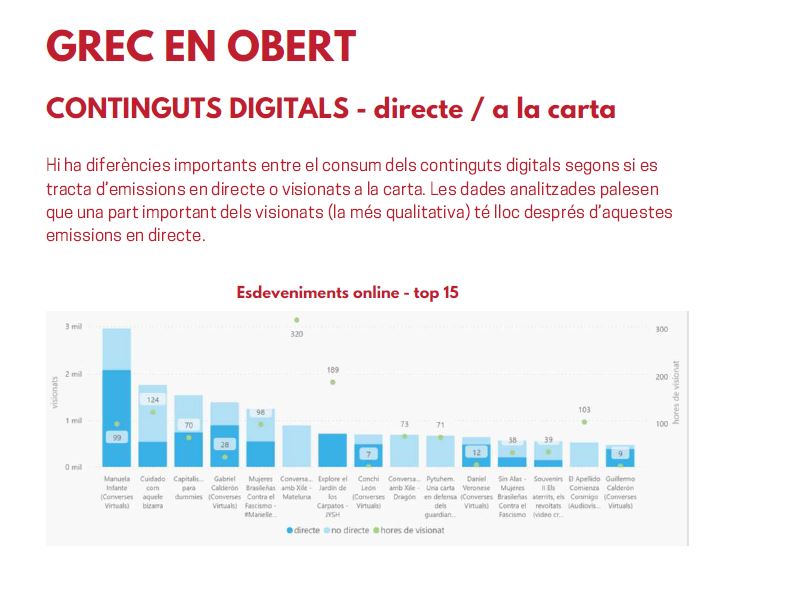
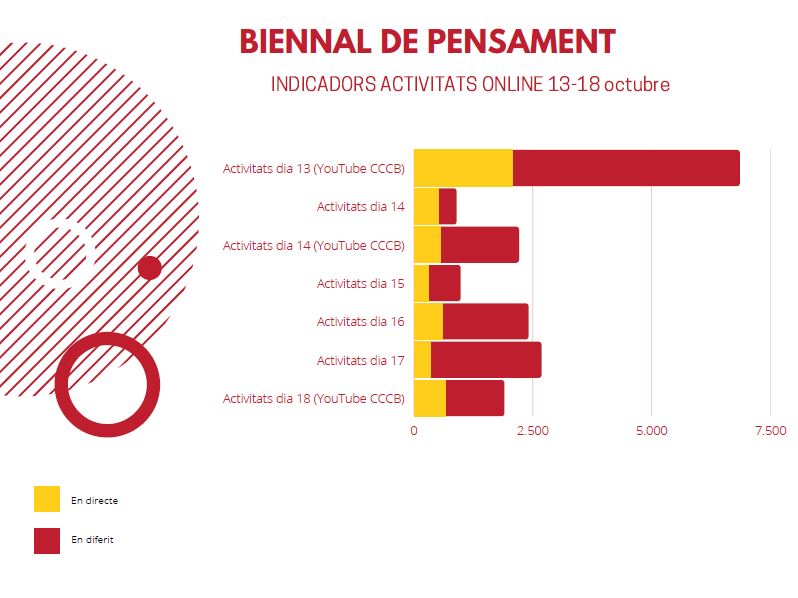
The pandemic and digital audiences


DIGITAL INDICATORS 2020

2020 was the year of Covid-19, a pandemic that has had devastating consequences for culture. But it was also the year of the generalised development of new strategies for reaching audiences, during a time when being on site was either prohibited or severely restricted.

In this context, and in very diverse ways, civic centres, museums, exhibition centres, creation factories, libraries, theatres and festivals all explored new ways of connecting with audiences and opened digital channels and platforms in order to respond to this new challenge. In some cases, this focused on school work, others generated activity on a more social and supportive level, while some opted for showing what was happening backstage. They were all projects that came out of collective effort and the need to reinvent oneself, and they were very well received.

Faced with this new reality, the Institute of Culture's Technical Officeworked with some of the cultural stakeholders involved, in order to obtain structured, uniform and comparable quantitative information on digital audiences, data which complement the information we already systematically compile about on-site audiences.

However, the digital world is very diverse, changeable and volatile, and agreeing on standards in such a short space of time was not possible. We will continue to work on it. However, we don't want to stop compiling data and showing, in some way, the efforts and the results of a digital activity that increased exponentially in 2020 and which is here to stay.

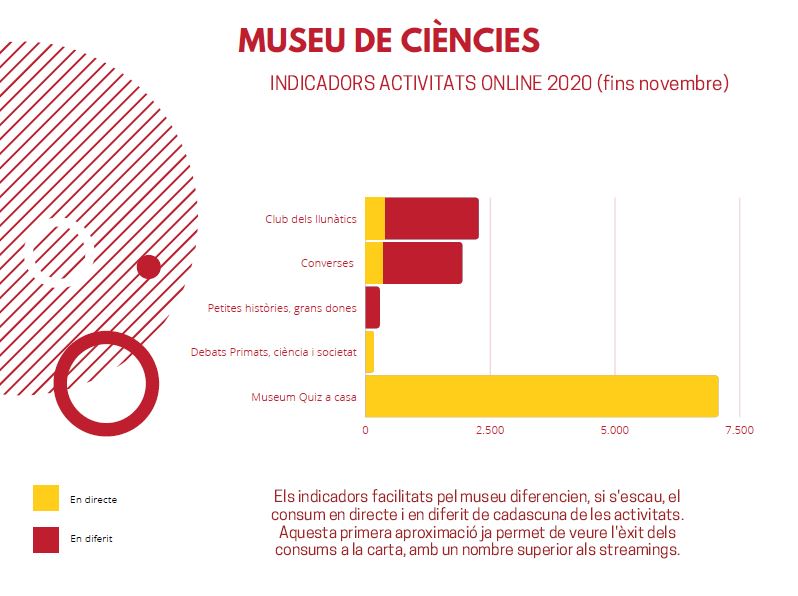
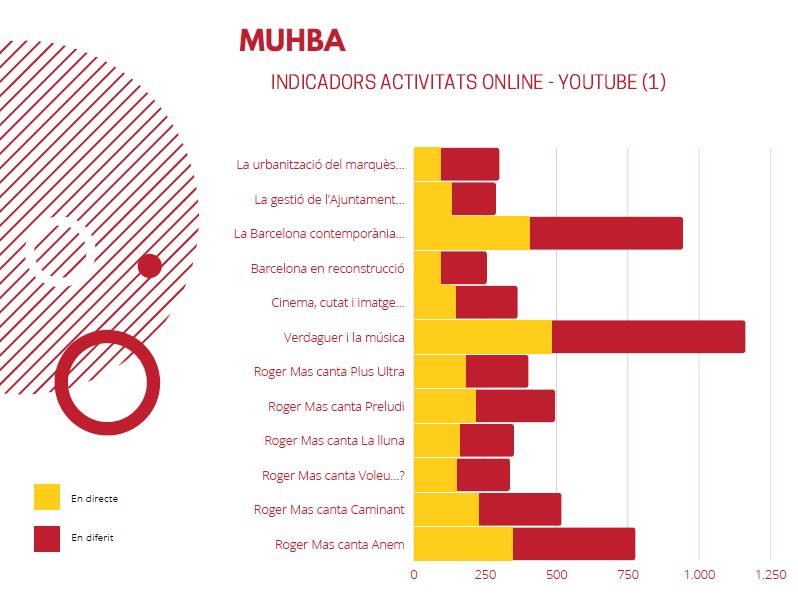
For all of those reasons, we present digital activity data and indicators for 2020 (in catalan), a compilation of some of the actions carried out. We know that this is a partial and incomplete compilation (and under permanent construction!). but we are sharing it with the aim of showcasing and recording the diversity of what is on offer, which is difficult to quantify, and the efforts made by stakeholders to continue creating culture in times of pandemic, exploring the possibilities offered by the digital world.